
 Von
Rolex counterfeits are becoming increasingly sophisticated: New clone movements even feature a free-sprung balance with Microstella weights.
A free-sprung balance with four characteristic Microstella regulating screws on the balance rim was long considered a distinguishing feature of genuine Rolex movements. However, in recent months, an increasing number of counterfeit Rolex watches have appeared on the market featuring the same mechanism, making authentication considerably more challenging.
The small, star-shaped weights on the balance rim represent a special approach to rate regulation that Rolex has employed for decades. While cases, dials, and bracelets can be copied relatively easily, reproducing a free-sprung balance has long been considered a much greater technical challenge.
Rolex balance rim featuring four Microstella screws and a Parachrom Bleu hairspring. © Rolex SA
However, even this technical hurdle appears to have been overcome. In recent months, an increasing number of counterfeits from China have emerged featuring free-sprung balances. Does this mean that a close examination of the escapement can no longer be considered a reliable way to distinguish genuine watches from replicas?
A Different Approach to Rate Regulation
To understand what makes Rolex’s system special, it is worth taking a closer look at conventional rate regulation. In many mechanical movements, the rate is adjusted using a so-called regulator. This changes the effective length of the balance spring.
Rolex takes a different approach with its Microstella system. Rather than changing the effective length of the hairspring, the moment of inertia of the balance wheel is adjusted. This is achieved through small, adjustable weights mounted on the balance rim. Moving or adjusting these weights inward or outward changes the balance wheel’s moment of inertia and, consequently, the rate of the movement.
The effective length of the hairspring itself remains unchanged. This is precisely the principle behind a free-sprung balance.
Microstella Made in China: The latest counterfeits feature an escapement closely resembling the original. © Editorial team
The concept itself is not new. Rolex developed its Microstella components as early as 1957, initially in the form of conventional screws. In 1983, they were redesigned and given the distinctive star shape familiar to many watch enthusiasts today.
This does not automatically make the construction more accurate than every conventionally regulated movement. A free-sprung balance also requires careful manufacturing, poising, and adjustment. The quality of the hairspring, its terminal curve, the balance staff bearings, and the overall tuning of the oscillating system remain crucial.
A New Benchmark for the Counterfeit Industry
Anyone familiar with counterfeit Rolex movements knows just how much their quality has evolved in recent years. Until only a few years ago, many replicas were relatively easy to identify. They often relied on movements such as clones of the ETA 2836 or even considerably cheaper, basic mechanical movements.

An older counterfeit of the Rolex Caliber 3135, with a clearly visible hairspring stud holder and regulator index used to adjust the movement. © Editorial team
Back in 2020, I published an article on Watchthusiast examining counterfeit Rolex movements. At the time, clone calibers such as the SA3135, SH3135, and VR3135 were among the movements I investigated. One significant difference compared with the original Rolex Caliber 3135 was the balance construction: Instead of a free-sprung balance with adjustable Microstella weights, the replicas examined featured conventional regulator-based adjustment.
This was a useful indication. Anyone able to inspect the movement with the caseback removed could identify a detail that raised questions about its authenticity.
But the technology did not stand still.
When the Replica Comes Ever Closer to the Original
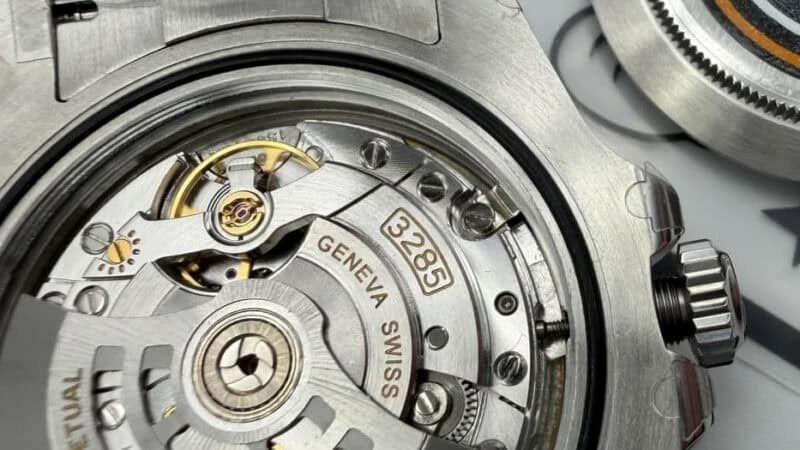
Research into newer clone calibers shows that free-sprung balances with functional Microstella screws on the balance rim are now appearing in counterfeit watches.
An original at first glance: The free-sprung balance takes this counterfeit to a whole new level. © Editorial team
The extent of this development becomes apparent when looking at how current Rolex replicas are marketed. A platform specializing in replica watches describes a new generation of movements from the so-called QF Factory, reportedly developed in cooperation with a manufacturer called JH. These movements are said to be used in watches from Rich Factory and Gold Maker Factory.
Their defining feature is a free-sprung balance with four gold-colored regulating weights. The traditional regulator system, with its characteristic regulator pins, is supposedly a thing of the past.
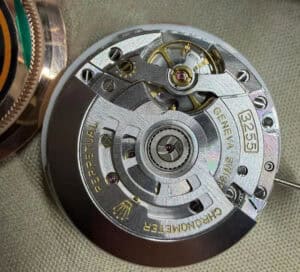
A Rich Factory watch equipped with the JH3255 caliber. © Editorial team
Particularly noteworthy is the claim that the new construction is not limited to individual models but is available for an entire range of Rolex calibers – from the Daytona chronograph to the Submariner and GMT-Master II. The technical resemblance to the original is explicitly promoted as a quality feature and selling point.
Whether the JH calibers actually achieve the technical quality claimed by their sellers cannot be determined from the product descriptions alone. Independent measurements, long-term tests, or documented examinations of the movements are still lacking. Images from so-called quality control processes do, however, suggest that the movements can achieve very good rate readings on timing machines. Nevertheless, these reports illustrate that the free-sprung balance has now become a deliberate part of the development and marketing of high-end Rolex replicas.
As a result, a detail that was long considered an indication of an authentic Rolex movement is steadily losing its value as a distinguishing feature. The counterfeit industry clearly has the ambition to reproduce movements down to the smallest detail.
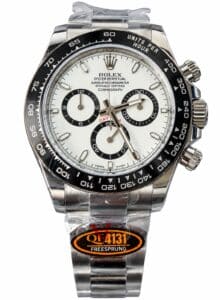
A Daytona from the new generation – the sticker on the bracelet prominently highlights the “freesprung” feature. © Editorial team
Such reports should be treated with a degree of caution. They do not originate from independent certification procedures and cannot necessarily be applied to all clone calibers on the market. However, they point to a development that is highly relevant to authentication: The mere presence of a free-sprung balance in a watch is no longer sufficient to confirm the authenticity of a Rolex movement.
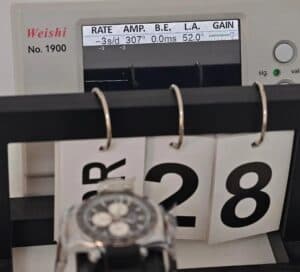
The quality control photo taken by a counterfeit dealer in April 2026 shows impressive rate readings for the new movement featuring a free-sprung balance. © Editorial team
This also applies when individual genuine components are installed in an otherwise counterfeit movement. This is the work of so-called modders, who have access to genuine spare parts and use them to upgrade counterfeit watches, making them even harder to identify.
What About the Blue Hairspring?
The blue Parachrom hairspring is also frequently cited in this context as a supposedly unmistakable sign of authenticity. Here, too, a more differentiated view is necessary. Manufacturers in Asia have long been using techniques to give hairsprings a similar blue appearance. This does not mean they achieve the same quality as the original. In principle, it is simply a coloring treatment applied to the surface.
Authenticity Lies in the Details – and How They Work Together
So, what remains of the Microstella balance as an identifying feature? It is still an interesting and important technical detail. However, it is no longer proof of the authenticity of a Rolex movement.
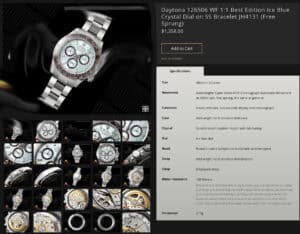
This Daytona featuring the new movement costs well over $1,000 at one of Hong Kong’s largest counterfeit watch dealers. © Editorial team
A reliable assessment must take the entire caliber into account: the construction of the balance and its bridge, the design of the hairspring, its mounting and bearings, the regulation system, the movement architecture, and the finishing of the individual components. It is also necessary to consider whether individual parts or entire assemblies may have been replaced.
With high-quality counterfeits, such an examination must be particularly thorough. Nevertheless, the implementation of the free-sprung balance represents a significant milestone for the counterfeit watch industry, which operates on an industrial scale with factories in China. Initial reports also suggest that Rolex counterfeits are not the only ones benefiting from this development. Free-sprung balances are reportedly beginning to appear in counterfeit luxury watches from other brands, including Patek Philippe.
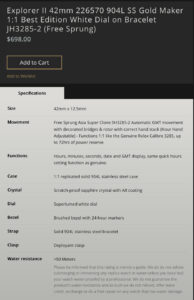
In the GMT-Master version, the new movement costs almost $700 – counterfeit watches are no longer bargains. © Editorial team
In the GMT-Master version, the new movement costs almost $700 – counterfeit watches are no longer bargains. © Editorial team
These watches are certainly not cheap. They are a far cry from the counterfeits sold for a few hundred dollars near tourist beaches. Some of the latest Rolex counterfeits cost anywhere from $700 to more than $1,000.