Von
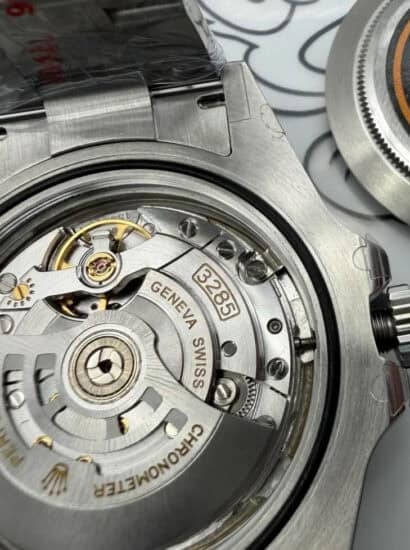
For almost 15 years, counterfeit versions of the Rolex Caliber 3135 have been on the market. Although the movement is not identical to the original in every detail, it is virtually indistinguishable at first glance. And counterfeiters have long since turned their attention to the successors of the 3135, cloning those calibers as well.
In the case of the Caliber 3135, the overall architecture corresponds to that of the original. Only the dimensions of the wheels and pinions are not consistently identical.

Which one is genuine and which is fake? The original Rolex movement is on the left, the counterfeit on the right. Some of the few visible differences, such as the missing cover plate on the balance bridge, have since been addressed. © Editorial team
Genuine Rolex hands and dials can be fitted to the clone without any problems. This not only makes it possible to create a convincing counterfeit, but also a so-called Frankenwatch. In these watches, genuine and counterfeit components are mixed, making it even harder to identify a fake, particularly in the case of vintage models.

A direct comparison makes the similarities – or, more accurately, the remaining differences – even easier to spot. © Editorial team
More recently, a Chinese manufacturer introduced a movement offering a 72-hour power reserve, with an appearance reminiscent of the movements used in IWC Portuguese watches. Visually appealing, it is also an interesting technical development. Two test watches delivered good rate results, each consistently achieving more than 70 hours of power reserve. Numerous components suggest that assemblies from clones of the ETA 2824 and Valjoux 7750 may have been used in its construction.

Its rate performance is very good. It operates at 28,800 vibrations per hour (vph) and offers a power reserve of more than 70 hours. © Thomas Gronenthal

Front view of the IWC Portuguese “Made in China”: The counterfeit is actually well finished. © Thomas Gronenthal
Rarity Is No Protection Against Counterfeiting
Even rare and technically sophisticated watches are copied. Hublot models are a case in point, with their exceptionally complex case construction. To produce replicas, counterfeiters dismantle original cases, measure their components and digitize the resulting data. This process is not always possible without damaging the original watch. The counterfeiters, however, are unconcerned about the cost: without dismantling a watch, producing a complete copy is extremely difficult.

Hublot replica: The inner case is made of steel, while the exterior features components made of ceramic and a special synthetic material. These components are interchangeable with those of a genuine watch. © Editorial team
The movements are then selected to match the originals as closely as possible. This is easiest with watches that use ETA movements. Brands in this category include Tudor, IWC and Panerai (models with hand-wound Unitas movements and Valjoux derivatives), as well as Hublot, which for many years used a base movement from another Swiss manufacturer that was identical in construction to the ETA Valjoux 7750.
The Manufacturers Behind the Fakes
Following a period of market consolidation in recent years – partly driven by cooperation between Swiss manufacturers and Chinese authorities – the larger factories are the ones that have largely survived. Some of them also manufacture components for legitimate watch brands.
As for the inspections, it is worth noting that they are conducted with roughly the level of rigor one might expect in China: anything deemed unnecessary is sacrificed, and every factory that is shut down is quickly replaced by another.

Using sophisticated manufacturing equipment, a rotor originally intended for an ETA movement becomes a Piaget rotor. © Editorial team
NOOB FACTORY – Particularly well known for its Rolex models, the factory also produces counterfeits bearing the names of Panerai, Audemars Piguet, Bell & Ross, Breitling, Cartier, Ebel, Franck Muller, Graham, IWC, Jacob & Co., Jaeger-LeCoultre, Montblanc, Omega, Porsche Design, Ulysse Nardin and Zenith.
H FACTORY – This manufacturer specializes in the Hublot Big Bang and Breitling Steelfish, as well as models from Panerai (PAM111 and PAM005), Chopard, Concord, Graham and IWC.
V6 FACTORY – Brands copied include Baume & Mercier, Cartier, Chaumet, Chopard, Corum, DeWitt, Franck Muller, Hublot, IWC, Louis Vuitton, Omega, Patek Philippe, Paul Picot, Roger Dubuis, TAG Heuer and U-Boat.
BP FACTORY – This manufacturer focuses on watches from IWC, Rolex, Panerai, TAG Heuer, Sinn, Patek Philippe, Bell & Ross, Breitling and Cartier. It is particularly well known for its so-called Rolex “Super Clone” models.
Z FACTORY – This factory primarily produces counterfeit watches bearing the names of Tudor, IWC and Panerai. Its specialties include the Tudor Pelagos and Black Bay, the Panerai PAM289 and PAM616, as well as the IWC Portuguese and special editions such as the ceramic IWC Top Gun.

A look inside a factory in China. © Editorial team
There is virtually no watch model that escapes counterfeiting. Even Tissot, Sinn and other brands that do not traditionally belong to the luxury watch segment are affected.
One curious detail is that inexpensive counterfeit watches are sometimes fitted with exactly the same movements used in their genuine counterparts. A case in point is the Tissot PRS 516 Chronograph, which contains an ETA G10 movement in both its legitimate and counterfeit versions.

Hublot components: Distinguishing genuine parts from counterfeits is no easy task. © Editorial team